Can’t remember maths?

Here is a collection of short videos to help adults who feel they may have forgotten what they learned at school or perhaps never got to grips with maths at all.

If you’re feeling a bit rusty when you want to check how much you’re spending, or make sure you’re getting a bargain when you shop, this website is for you.

I’m Tessa Tulloch and I taught basic maths to adults for many years.  I made these videos to help people who think they “can’t do maths” and convince them that they can!

I describe maths as rather like a wall.  You need to build up your knowledge brick by brick.  If for any reason you missed the early stages – you may have been ill or moved schools – it is hard to make progress.  You may just give up.

But I am here to help. You can see all the videos on my YouTube channel” https://www.youtube.com/@cantremembermaths

Have a look at the list of topics I cover on the Numbers topics page.

And see my suggestions as to How to use these videos.

Numbers topics
1. Why numbers are in columns

We write numbers in columns of ones (units), tens, hundreds and so on. This is the basis of all our calculations such as adding and subtracting. You may see it referred to as “place value” or “number value”.

5. Multiplication

Times tables are really useful, but if you can’t remember, or were never taught them, it’s easy to draw a grid, or multiplication square, to use instead. You’ll progress from short to long multiplication, and you’ll find that your fingers help.

2. Even and odd numbers

All numbers are either even or odd. Even numbers can be divided by two. Odd numbers can’t. You can tell which is which by looking at the last digit.

6. Division

In a way division is the opposite of multiplication. Dividing by small numbers is known as short division and by big ones as long division. Division with remainders, or numbers left over, leads us into fractions and decimals.

3. Adding

Often referred to as “doing sums”, adding numbers in columns is a most useful skill. You’ll learn how to carry numbers left over into the next column.

7. Fractions

Quarter of a pizza or two thirds of a cake, fractions are practical applications of maths in everyday life. You’ll find them useful, for example, when dividing up a bill in a café.

4. Subtracting

Taking one number away from another is also done in columns. As with adding, you’ll learn how to check that you’ve got the answer right.

8. Decimals

The metric system is based on tens, so putting numbers in columns helps with multiplying, as well as adding and subtracting, and knowing where to put the decimal point.

How to use these videos

These video tutorials are short (about 2-5 minutes each), clear and specific.  Each one deals with a topic that you may have found hard, such as fractions, and takes you through it quite slowly in easy steps.

Some are basic – adding and subtracting, for example.  Some are more advanced, such as decimals.

You have three ways of using these videos.

1. Sample

Try this one about fractions; it involves cake and chocolate:

2. Overview

For an overview of how the videos cover all the eight main topics, starting with why we put numbers in columns up to working with decimals, have a look at a playlist called Basic calculations.

3. Individual topics

If you’d like to focus on a particular topic you’ve had difficulty with, you’ll find videos in playlists under the same eight titles:

About me

I taught maths, mostly arithmetic, to adults for many years at an adult education college, first in Kent and more recently in Hampshire.

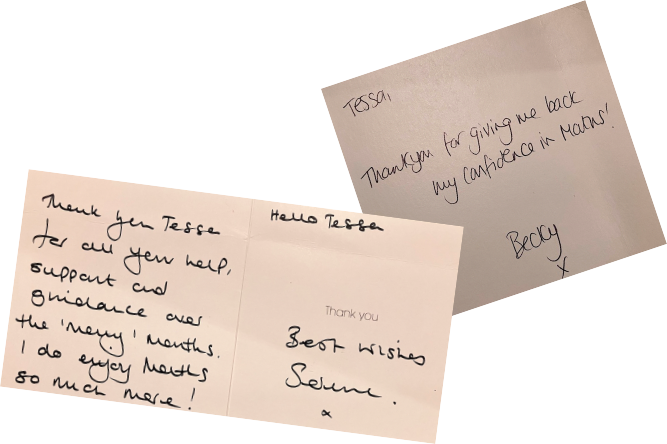
I was distressed when the college stopped providing the courses I had been running as I was sure they had been useful.  Indeed several former students said they were grateful for them.  See some testimonials below.

I didn’t want the dozens of videos I had made, with help of a brilliant photographer, Adrian Harvey, to sit in a drawer for the rest of my life.  So I gathered them together and am making sure they are available online for anyone who might find them helpful.

Testimonials

I’ve chosen two hand-written testimonials from former students of mine. The important thing for me is that they lost their fear of maths and began to enjoy doing sums, fractions and all the other calculations.
Contact